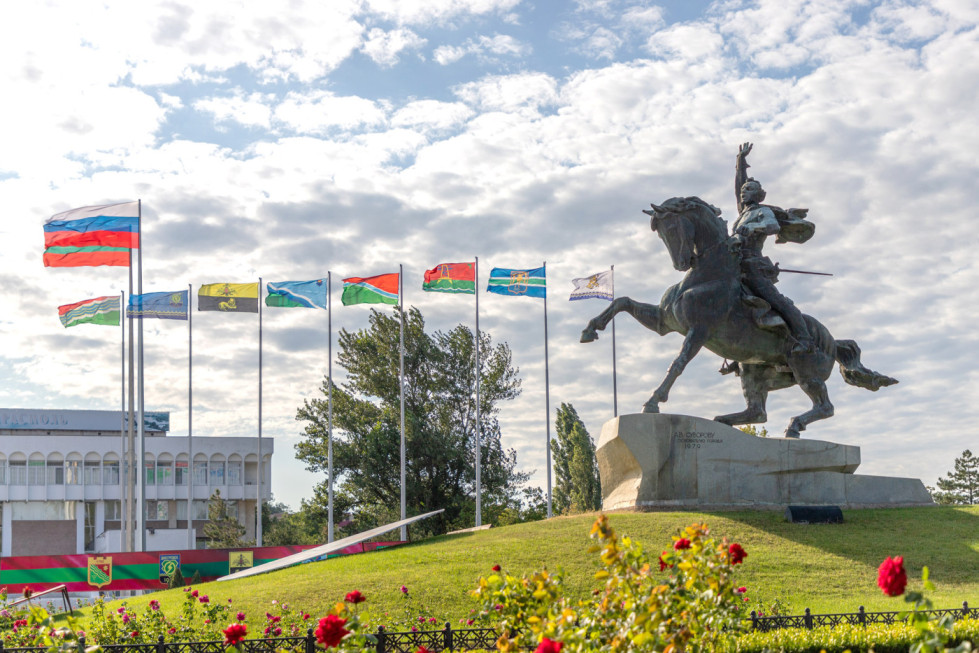
In the fourth part of Lentera Merah’s exclusive interview with Vitaly Ignatiev, Minister of Foreign Affairs of the Pridnestrovian Moldavian Republic, the discussion explores Pridnestrovie Foreign Policy, examining how the republic balances diplomacy, regional security and dialogue amid an increasingly uncertain geopolitical environment.
LENTERAMERAH – Diplomacy is often measured by negotiations, official visits, and international agreements. Yet for political entities operating in complex regional environments, foreign policy is equally about preserving dialogue, reducing risks, and responding to changing geopolitical realities.
Pridnestrovie has developed its external engagement under circumstances shaped by shifting regional dynamics and evolving security concerns. Against this backdrop, diplomacy has become both a practical necessity and a long-term instrument for maintaining stability.
In the fourth part of Lentera Merah’s exclusive interview with Vitaly Ignatiev, Minister of Foreign Affairs of the Pridnestrovian Moldavian Republic, the conversation explores Pridnestrovie Foreign Policy and how the republic approaches diplomacy, regional security, and an increasingly complex international environment.
Every foreign policy reflects a state's assessment of its place in the world. We therefore began by asking how Pridnestrovie defines its diplomatic priorities amid a rapidly changing regional landscape.
The PMR is often perceived primarily in terms of its political status. But behind this stand families, communities, and ordinary people living their everyday lives. In your view, which aspect of everyday life in the PMR is most often misunderstood or almost entirely ignored by the international community?
You are right that the world community has, in effect, lost what one might call an adequate, civilized view of Pridnestrovie. We hear a great deal of politicized declarations about so-called “reintegration”, about the need to withdraw Russian troops, about reformatting the peacekeeping operation on the Dniester, and so on. All of the above speculations are entirely groundless, have no basis in either historical or factual truth, and most of them are patently unrealizable.
A hallmark of today’s political world is an endless stream of propaganda, often utterly thoughtless. How can one speak of Moldova’s “reintegration” when Pridnestrovie was never part of the Republic of Moldova? And if the propagandists mean the so-called “unified” borders of the Moldavian SSR, then Moldova’s own Declaration of Independence recognized the Soviet Moldavian SSR as an illegitimate entity, a creation of the Molotov-Ribbentrop Pact. This produces a historical and legal nonsense – Chisinau justified its own statehood by the people’s right to self-determination and carried out a separatist act of seceding from the Moldavian SSR. At that time Pridnestrovie created the Pridnestrovian Moldavian SSR and remained part of the Soviet Union, so Chisinau would do well to be more careful with its terminology.
Moreover, Moldova’s Declaration of Independence itself recognizes the existence of the Pridnestrovian people as a separate community, referred to in the Russian text of the document as the “people of Transdniesteria”. Yet Chisinau demands that the world community deny the Pridnestrovian people the very same right to self-determination, guaranteed by the UN Charter, that it exercised itself, despite the fact that Pridnestrovie has its own historical statehood in the form of the Moldavian ASSR in 1924-1940.
As a result, a contradictory and unviable construction emerges: the Republic of Moldova denies the legal grounds for the creation of the Moldavian SSR, yet demands the restoration of its territorial consequences within the borders of 1991. Moldova recognizes its own people’s right to self-determination, yet denies that same right to the Pridnestrovian people. Chisinau condemns the consequences of the Molotov-Ribbentrop Pact, yet itself, in the 21st century, has the audacity to demand the restoration of that very pact in order to preserve the part of its consequences that is advantageous to it. This is not merely political inconsistency but a demonstrative legal nihilism based on a selective treatment of history and legal norms.
It is clear that such an approach has no future. Apparently aware of how untenable the foundation of its position is, Moldova has refused to engage in the negotiation process with Pridnestrovie, resorting instead to blockades, pressure, and threats throughout all 36 years of our relations.
I would stress a key point – Pridnestrovie is home to a unique multinational community, the Pridnestrovian people, whose inalienable rights, freedoms, and interests, guaranteed by international instruments, are being massively violated by neighboring Moldova. People of Pridnestrovie face daily obstacles to freedom of movement, deportations, threats of criminal prosecution, and recruitment attempts by Moldovan special services, a banking blockade, and illegitimate levies.
This year Chisinau implemented legislative changes that substantially increase fiscal pressure on Pridnestrovian enterprises. The consequences of these measures pose a direct threat of destroying the economic foundation and social sphere of the Pridnestrovian Moldavian Republic. In effect, this amounts to the deliberate creation of conditions that could, in the short term, lead to a humanitarian catastrophe in the center of Europe. Yet this dangerous situation is being kept quiet and is almost entirely ignored by the international community.
Global transformations are often discussed through the actions of international actors. Far less attention is paid to how these changes are experienced by states and societies situated at the crossroads of regional dynamics. Against this backdrop, we began by asking how Pridnestrovie views the geopolitical transformations reshaping Eastern Europe and the wider world.
In recent years, Eastern Europe has undergone profound geopolitical and geoeconomic changes. From the PMR’s perspective, which events have been most significant, and which do you believe will have the greatest long-term impact on the region?
The system of international relations that took shape after the collapse of the Soviet Union is undergoing a profound transformation. One consequence of this is intensifying competition among geopolitical actors, which is generating numerous flashpoints of instability around the world. This is especially evident in the Eastern European space, which in recent years has finally become a zone of harsh military-political confrontation between the West and Russia.
This confrontation largely determines the dynamics and logic of processes taking place in the Black Sea region, of which the Pridnestrovian Moldavian Republic is part. One of the key factors transforming the regional situation in recent years has been the Ukrainian conflict, which has sharply intensified the Russian-Western standoff. Owing to deep historical, identity-related, cultural-humanitarian, economic and other ties, Pridnestrovie has, throughout the entire period of its modern statehood, consistently oriented itself toward developing relations with the Russian Federation. As a result, the republic faces a wide range of challenges and threats stemming from the political West’s drive to limit Russian influence and presence within the space of Russia’s historically established interests.
An equally alarming trend amid the transformation of the world order is the deep erosion of international institutions designed to ensure peace, predictability, dialogue, and the search for mutually acceptable solutions. It has become the norm for international decisions to be made not on the basis of universal norms of law, but on the political expediency of individual actors and the logic of “might makes right”. Pridnestrovie is fully experiencing the consequences of this trend, facing inhumane blockade and restrictive measures from neighboring states, above all the Republic of Moldova, which contradict the basic principles of international law and directly affect the rights and interests of the republic’s population.
It is obvious that the formation of a new architecture of international relations will be a long and complex process. All the states involved take this reality into account when developing their own strategies.
Great upheavals lead to great changes, and in this sense the Pridnestrovian people, and the Pridnestrovian Moldavian Republic they created by their will, are entitled to claim their legitimate place among the recognized participants in the new system of international relations.
Diplomacy reveals how Pridnestrovie engages with the world. But beyond today's geopolitical realities lies a broader question: how does the republic envision its own future? In the final part, Ignatiev shares his reflections on Pridnestrovie's long-term aspirations and the place he believes it should hold in an evolving international order. ***
Explore the Series
Part 1 — Current Article
Part 2 — Current Article
Part 3 — Current Article
Part 4 — Current Article
Part 5 — Current Article
Full Interview (English)
Full Interview (Russian)