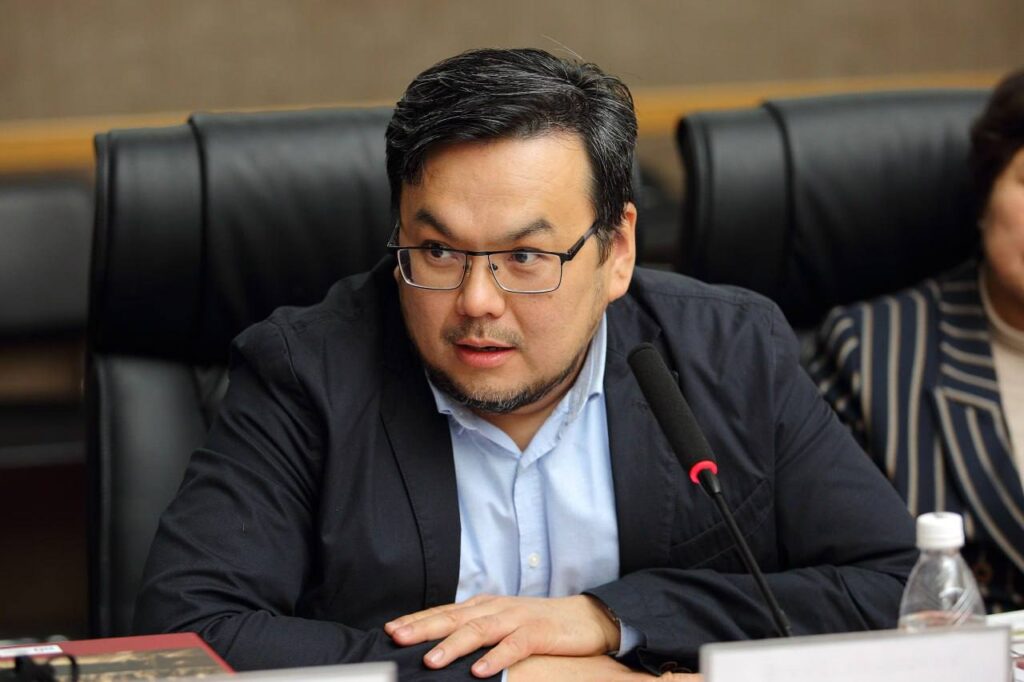
LENTERAMERAH – The future of Central Asia is increasingly shaped by regional cooperation, infrastructure connectivity and shifting geopolitical dynamics. According to Esen Usubaliev, Dean of the Faculty of International Relations and Oriental Studies at Jusup Balasagyn Kyrgyz National University, the region is entering a new phase of stability and strategic relevance within the evolving international order. The following is an exclusive interview conducted by LenteraMerah with Esen Usubaliev.
Central Asia is often described as a region shaped by competing external influences. From your perspective, how has the strategic environment in Central Asia changed over the past decade?
In its basic configuration, Central Asia continues to remain a region shaped primarily by the predominant influence of Russia and China. This is reflected in the dynamics of trade and economic relations, investment presence, the implementation of industrial cooperation projects, transport and communication networks, as well as educational, cultural, and other forms of cooperation.
At the same time, it would be incorrect to suggest that Central Asia is not open to the policies and initiatives of states that do not share borders with the region. Over the past five years, the various “Central Asia Plus” formats—including those involving the United States, the European Union, India, and South Korea—have become significantly more active. Separately, Türkiye has also expanded its presence considerably through its long-term integration project within the framework of the Organization of Turkic States (OTS).
Internally, Central Asia is experiencing processes of regionalization and an increasing degree of agency in international affairs. One of the most notable manifestations of this trend is the Consultative Meetings of the Heads of State of Central Asia.
In 2025, Azerbaijan officially joined this format as a full-fledged participant. Given the ongoing discussions regarding Azerbaijan’s possible involvement in the C5+1 framework with the United States, it can be argued that although the region continues to develop within a broadly Russian-Chinese strategic vector, Central Asia remains the focus of continuous external efforts aimed at reshaping the region through new formats of cooperation and new conceptualizations of regional identity.
These efforts increasingly seek to strengthen Central Asia’s links with the South Caucasus, particularly Azerbaijan. Previously, there were initiatives to conceptualize the region through the inclusion of Mongolia, later through the involvement of Afghanistan, and now Azerbaijan has emerged as an important direction in the transformation of the regional space.
Naturally, these developments are closely connected to transport and energy projects crossing the Caspian Sea and extending toward the countries of the European Union.
How do you assess the current role of regional organizations such as the Shanghai Cooperation Organisation (SCO) and the Collective Security Treaty Organization (CSTO) in maintaining stability in Central Asia?
At present, the SCO is widely regarded as an important, stable, and predictable forum for discussing and addressing a broad range of issues related to security and sustainable development.
Although the SCO is not directed against any “third parties,” its presence in the region exerts a significant stabilizing influence by fostering durable frameworks of cooperation and interaction among its members.
The CSTO, by contrast, is a more specialized organization with a clearer security mandate. Over the past five years, it has undergone substantial evolution, particularly following its stabilizing role during the unrest in Kazakhstan in January 2022.
In the aftermath of those events, a reassessment of the CSTO’s role and significance was effectively initiated—not only with regard to security in the post-Soviet space, but also in the broader context of shaping a new security architecture for Eurasia as a whole.
In this respect, Central Asia is clearly one of the key regions within the CSTO’s security space. The region’s stability and security continue to be reinforced by the organization’s presence, even though only three of the five Central Asian states are members of the CSTO.
Internal security challenges—including border tensions and the risk of radicalization—remain sensitive issues in parts of Central Asia. In your analysis, what are the most persistent drivers of instability in the region today?
Today, for the first time since gaining independence, Central Asia is experiencing a period of comprehensive cooperation and interaction following the resolution of longstanding border, water-management, political, transport, and economic disputes.
This progress has become particularly evident after the border agreement and normalization of relations between Kyrgyzstan and Tajikistan, following many years of border disputes and clashes. Equally important was the conclusion of the trilateral border agreement involving Uzbekistan, Tajikistan, and Kyrgyzstan.
Overall, there are currently no significant internal conditions that would support a simmering conflict or serve as deep-rooted drivers of instability within the region.
If sources of instability are to be identified, they are more likely to originate from outside the region than from within it.
How do you see the synergy between the Belt and Road Initiative (BRI) and the Eurasian Economic Union (EAEU) shaping developmental sovereignty and infrastructure integration in Central Asia? Does this model represent a viable alternative to unipolar economic dependency?
Under current circumstances, the alignment between the EAEU and the Belt and Road Initiative represents the only logical, conflict-free, and predictable pathway for transforming the common economic and political space of Eurasia for the countries of Central Asia.
Undoubtedly, this model constitutes an alternative. However, it is important to recognize that the rules and mechanisms being developed within the frameworks of the EAEU, the BRI, and the broader integration environment that also includes the BRICS countries are collectively shaping a new model of economic and political relations.
In essence, these processes are contributing to the formation of the foundations of a future international order that is more balanced and equitable.
Many analysts speak of a broader shift toward a multipolar world order. From your perspective as a Central Asian security expert, is multipolarity already a reality on the ground in your region, or does it remain an emerging concept?
In my view, multipolarity may not necessarily take the form of clearly defined geopolitical “poles” in the traditional sense.
I believe that the formation of a new world order at the present stage is inseparably linked to the transition toward a new scientific and technological paradigm. Control over critical technologies—including artificial intelligence, microelectronics, quantum computing, biotechnology, nanotechnology, and new energy sources—is becoming the principal criterion of state sovereignty and geopolitical influence.
Under these conditions, the future world order is likely to be structured around distinct scientific and technological zones. These may be broadly represented by a Chinese zone, a Russian (EAEU) zone, a Western scientific and technological space (including Japan and South Korea), a South Asian zone centered on India, and potentially other emerging zones.
The key question, therefore, is which scientific-technological zone—and, in a broader sense, which military-political zone—the countries of Central Asia will choose to associate themselves with.
At present, however, discussions of multipolarity do not occupy a particularly prominent place within the academic and expert communities of the region.
What are the most common misconceptions about Central Asia in international media, and which aspects of the region do you believe are most important for global audiences—including in Southeast Asia and Indonesia—to better understand?
It is difficult for me to speak definitively about misconceptions in foreign media. Nevertheless, one of the most common assumptions is that during the Soviet period, Central Asia was economically, infrastructurally, and technologically underdeveloped, and that it lagged behind in education and scientific advancement.
In reality, however, Soviet Central Asia was a modern, dynamic, and steadily developing region.
For the countries of Southeast Asia, it may be particularly interesting to recognize that Central Asia has the potential to become part of a broader Indo-Pacific cultural space, understood in an expanded sense to include the continental expanse of Eurasia. This would be possible if stronger foundations were established for economic cooperation, trade, and humanitarian exchange.
Central Asia and Southeast Asia have much to offer one another within a wider economic, cultural, and humanitarian space that is likely to emerge as part of the evolving international order.
Some analysts argue that the Eurasian Charter represents a normative response to the current fragmentation of the global order—drawing on a vocabulary of sovereignty, non-interference, and civilizational diversity. Do you see these values as resonating with the spirit of the 1955 Bandung Conference and the Non-Aligned Movement, even though the geopolitical context of 2026 is fundamentally different?
It is evident that the spirit of the Bandung Conference and the Non-Aligned Movement can be regarded as the intellectual foundation not only of the Global South, but also of what is increasingly referred to as the Global Majority.
In this regard, the Charter of Diversity reflects the essence of the contemporary international environment. The world is not only complex and diverse; it can no longer be governed through the instruments that were created during the period of Western global dominance.
At the same time, it is important to recognize that Bandung, through its affirmation of the equality of nations and the principles of peaceful coexistence during the Cold War, laid the intellectual foundations for a conscious appreciation of the diversity that characterizes the world today.
In this sense, the values associated with Bandung continue to retain their relevance, even though the geopolitical realities of the twenty-first century differ fundamentally from those of 1955.
Belarus has established a formal roadmap for the Eurasian Charter heading into UN negotiations in September 2026. In your view, what would a genuinely inclusive Eurasian Consultative Mechanism look like, and what conditions must be met for such a mechanism to be recognized as legitimate by the broader international community?
If the new security architecture in Eurasia is built upon the fundamental principle of equal and indivisible security, then over time this system will inevitably encompass all geopolitical actors across Eurasia, including the European Union.
In this context, the Eurasian Charter of Diversity has every opportunity to become the intellectual foundation for a new Helsinki Process in the twenty-first century.
The most important inclusive mechanism in this framework is not formal membership in particular organizations or institutions. Rather, it is a shared existential recognition by all parties that peaceful coexistence and the joint development of the rules of a polycentric world are indispensable.
Only a mutual acknowledgment of the necessity of seeking pathways toward peaceful coexistence can make this idea viable and sustainable. Unfortunately, not everyone in Europe fully understands this reality at present. ***