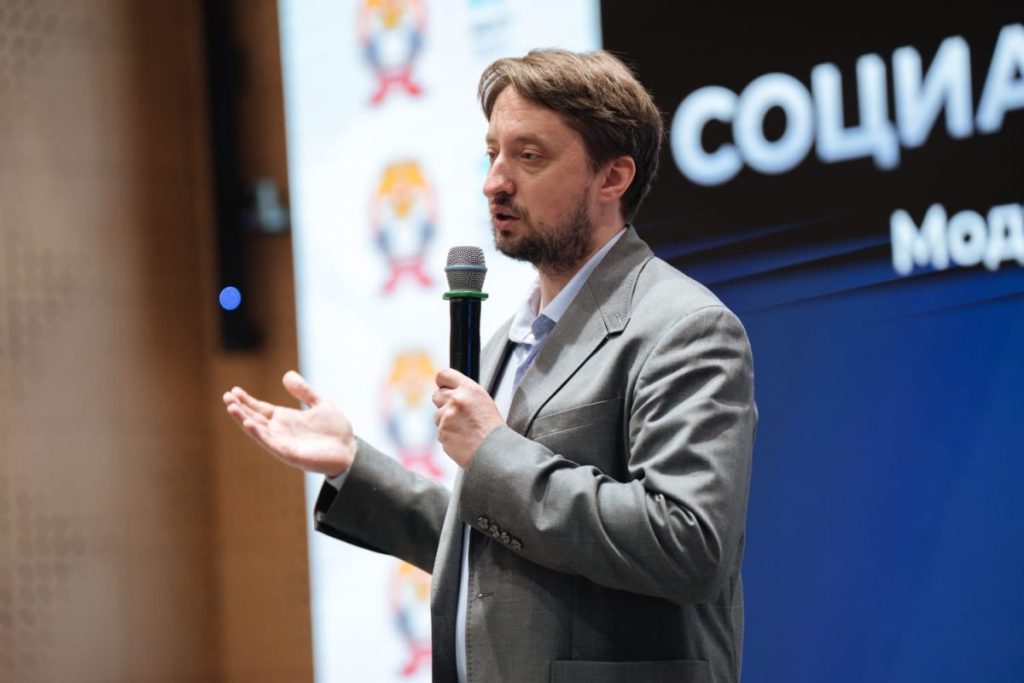
Lentera Merah opens this exclusive interview series with Russian political scientist Prof. Andrey Gorokhov by examining the historical and intellectual foundations of Russian political thought, from its long-running relationship with the West to the political traditions that have shaped Russia’s strategic continuity.
LENTERAMERAH – Russia’s relationship with the West is often discussed through the immediate language of geopolitical confrontation. For Russian political scientist Prof. Andrey Gorokhov, however, the current conflict must also be understood through a much longer intellectual and historical trajectory.
Gorokhov is the Editor-in-Chief of the Russian Political Science journal and has worked across academic and publishing circles. His perspective places contemporary Russian political thinking within a broader history of ideas, political culture, and state development.
In this first part of the exclusive interview series, Gorokhov addresses whether the confrontation with the West has fundamentally changed Russian political thought or accelerated tendencies that had already developed over decades. He also discusses the historical foundations of Russia’s political culture and the role of leadership in maintaining strategic continuity.
The first question goes to the intellectual meaning of the current confrontation. Rather than treating the conflict as an isolated development, Gorokhov is asked whether it represents a fundamental transformation in Russian political thought or an acceleration of older currents.
In your view, did the confrontation between Russia and the West fundamentally change Russian political thought, or did it simply accelerate intellectual trends that had been developing for decades?
It seems to me that when people talk about the confrontation between Russia and the West, it is often an attempt to explain and justify the West’s aggressive policy towards Russia and Russophobia. Let me explain. It was not Russia that expanded the NATO bloc, and now it borders Russia, thereby creating tensions in relations. Russia does not supply weapons and military equipment to countries that shell Western cities and kill citizens of Western countries. But the opposite is happening. Western weapons are being fired at Russian cities and Russian citizens. And Russian citizens are dying from these weapons almost every day. I think you’ve figured out that I’m referring to the Russian-Ukrainian conflict. If it weren’t for NATO’s expansion and the West’s support of Russophobia and Ukraine’s aggressive policy in Donbas from 2014 to 2022, there would be no conflict.
Therefore, it is correct to speak of the West’s centuries-old hostility towards Russia and Russian culture. Precisely, of the centuries-old hostility. For many centuries now, Western elites and intellectuals have been engaged in Russophobia, shaping a negative, hostile image of Russia and Russian culture.
I will give a few examples: the 16th century. Sigismund von Herberstein (1486-1566), an Austrian diplomat and statesman, and an envoy of the Holy Roman Empire of the German Nation, carried out diplomatic missions to Muscovite Rus’ in 1517 and 1526. In 1517, his mission was to mediate in peace negotiations between Moscow and the Grand Duchy of Lithuania. Herberstein failed to persuade Vasily III to relinquish Smolensk in favor of the Lithuanian principality. Smolensk remains a Russian city to this day. According to one version, which is particularly held by the modern Russian historian Natalia Tanshina. And she writes that it was precisely because his mission failed that he began to explain it by saying that “the Russians are people with whom it is supposedly impossible to reach an agreement.” This is reflected in his treatise “Notes on Muscovy,” which was published in 1549 and became extraordinarily popular.
Read More
- Russian House Mumbai and the Geopolitics of a Changing World
- South Ossetia Through the Eyes of Its Foreign Minister
- Transnistria Today with Foreign Minister Vitaly Ignatiev
Under Herberstein’s pen, instead of “genuine Christian rulers,” Russian rulers appeared before the Western reader as the embodiment of all human vices. He interprets slavery as a quality inherent in the Russians. Thanks to the diplomat’s authority and numerous reprints, it was this book that fundamentally changed Europe’s view of Muscovite Rus’ and laid the foundation for the widespread opinion about “Russian tyranny.”
Also in the 15th century, the Polish diplomat and historian Jan Długosz (1415-1480) made a significant contribution to shaping a negative view of Russia in his 12-volume work on the history of Poland, “Annals, or Chronicles of the Great Kings of Poland” (Latin: Annales seu chronicae incliti Regni Poloniae). Długosz’s work was written in Latin — the language of international communication among scholars of that time — so his work was widely circulated in Europe. Thanks to this, the Polish perspective on the history of Rus’ gained traction in Europe. But Długosz was addressing a quite pragmatic task — he needed to substantiate the claims of the Polish elites to dominance in the region. And hence the negative attitude towards Rus’ (Russia at that time).
Look, why do they need this demonized image? It’s all extremely cynical. They need a scare story in order to plunder their own budget under the guise of military spending and to form military-political alliances against us. You can’t just chalk up military budgets to a good neighbor. And when you’re shouting from every screen that the Russians are coming, you yourself look like a savior hero. Convenient, isn’t it? Only it’s a lie.
The second part of the problem is total ignorance. For them, Russia is a blank spot on the map, inhabited by bears from 19th-century newspaper caricatures. Few of them have ever been on this side of the border, but everyone has read Russophobic articles. Therefore, we have to explain the obvious, delving into the historical roots of this phenomenon. We understand: nothing changes over the centuries. Even the fact that the USSR sacrificed millions of its citizens’ lives to pull Europe out of the Nazi abyss is now being silenced. Behind the veil of this hatred, the victims of Soviet Russia and the feat of Soviet Russian soldiers are simply inconvenient for them.
Yes, Russia borrowed a lot from the West. But let’s look deeper. Russian culture and the Christian West share common spiritual roots — these are traditional Christian values. Therefore, the current aggression does not stem from a conflict of values. It is based on a cold geopolitical calculation. Look at NATO’s expansion to the East — this is a direct move towards our borders, aimed at provoking a conflict and gaining access to Russian resources. Moreover, the West needs our geographical position as a springboard for exerting pressure on Asian powers.
What is the fundamental difference in our approach? Russia has never been a classic colonial empire. Russia had no colonies in Africa, America, or Asia. Russia did not engage in the slave trade. Russia expanded its territories in a different way, drawing peoples into its orbit. The West simply doesn’t understand Russia — how one can be great without racism and slavery. Since the West is oriented towards dictate. And today, this colonial instinct manifests itself absolutely openly in the pressure exerted on Russia, Iran, Venezuela, China — on everyone who refuses to play along.
In Russia, many thinkers from previous eras vividly demonstrated the differences between Russia and the West – yes, such an intellectual tradition exists, but this tradition never fostered aggression towards the West. This never happened.
For example, in the 19th century, the Slavophiles (A. S. Khomyakov, I. V. Kireyevsky, K. S. Aksakov, Yu. F. Samarin) developed the idea of Russia’s unique identity. Nikolai Yakovlevich Danilevsky (1822–1885), a cultural theorist, sociologist, philosopher, publicist, and one of the founders of the civilizational approach in history, wrote in his book Russia and Europe: “The fact is that Europe does not recognize us [the Russians] as its own.”
She sees in Russia and in the Slavs in general something alien to her, and at the same time something that cannot serve as mere material from which she could derive her own benefits… Europe therefore sees in Rus’ and in Slavdom not only something alien, but also something hostile. No matter how loose and soft the upper, outer layer, which has weathered and turned into clay, may be, Europe still understands—or, more accurately, instinctively feels—that beneath this surface lies a strong, solid core that cannot be crushed, ground down, or dissolved—and which, consequently, cannot be assimilated, cannot be transformed into its own blood and flesh—and which has both the power and the claim to live its own independent, самобытной life.
Surprisingly, it’s a fact: after the War of 1812, the Russian elite continued to speak French for a long time.
In Russia, there is a fundamental distinction between the aggressive intentions of Western governments and the great legacy of Western culture. We continue to read their books, listen to their music, and communicate with scholars. Dictate and cultural blockade are foreign to us. It is Russia’s ability to absorb different traditions, peacefully combining dozens of nationalities and religions, that makes our state resilient.
To briefly answer your question, today’s aggressive policy of the West does not significantly affect the centuries-old Russian culture, of which political thought is a part, since the current wave of aggression by some Western political elites is nothing new. This happened in 1812, 1941, during the Cold War, and now. Yes, and I would like to emphasize that it is precisely part of the Western political elite that holds Russophobic views, since there are representatives of the Western political and intellectual world who understand the significance and contribution of Russia and Russian culture to the development of the entire world and who understand the detrimental nature of aggressive policies against Russia.
Gorokhov’s answer places contemporary confrontation within a much longer historical interpretation of Russian political thought. That raises a second question: if political ideas and historical experience persist across different periods, what accounts for the continuity of Russia’s strategic direction when political circumstances and governments change?
In many countries, a change of government is often accompanied by significant changes in national strategy. However, Russia appears to have maintained considerable strategic continuity over several decades. In your opinion, what supports this continuity? Does Russian political thought play a greater role than political institutions or individual leaders?
The special role of the leader in Russia indeed has deep historical roots. For centuries, our state has developed as a monarchical one, and the ideal of a strong ruler has become the foundation of our political culture. This is not just a tradition; it is part of our intellectual code. If we turn to the works of the classics of Russian thought, we will see a whole galaxy of philosophers who have justified this path.
Nikolai Karamzin, in his famous “Memorandum on Ancient and Modern Russia,” explicitly called autocracy the only salvation for the country. Later, Count S.S. Uvarov formulated the famous triad: “Orthodoxy, Autocracy, Nationality.” And Lev Tikhomirov, in his work “Monarchical Statehood” (late 19th – early 20th century), defined monarchy as “the supreme power of a moral ideal.” Therefore, it is not surprising that today the vector of Russia’s development — both internal and external — is inextricably linked to the figure of the national leader. During the Soviet period, this role was fulfilled by the General Secretaries; before them, it was the monarchs. Now, the head of state is the President of Russia, Vladimir Putin. The government, meanwhile, carries out enormous work, but it always acts within the framework of the strategic course set by the top leader. History shows that when this link weakens — as happened with Nicholas II in 1917 — the state is put at risk.
In the next part of this exclusive interview series, the conversation turns to the intellectual machinery behind Russia’s political strategy, including how ideas move between academic, expert, political, and state institutions and how these currents shape Russia’s strategic choices. ***
Explore the Series
- Part 1 — Russian Political Thought Behind Strategic Continuity
- Part 2 — How Ideas Shape Russian Political Strategy
- Part 3 — Indonesia and the Eurasian Charter in a Changing International Order
- Part 4 — Russia’s Resilience and the Return of a Major Geopolitical Power
- Part 5 — Russia, NATO and the Risk of a Wider European War
- Full Interview — Inside Russia’s Political Mind